Wealth Management's Kodak Moment
Nov 18, 2026· 8 min read
Kodak saw it coming
Kodak invented the digital camera. An engineer there, Steve Sasson, built the first working prototype in 1975, and the company still filed for bankruptcy in 2012.
The failure wasn’t lack of foresight. Kodak understood the technology early. It couldn’t build a business that survived the transition, because film was a cash cow and digital cannibalized it.
I think wealth management is approaching a similar moment. The analogy fits the product layer best: portfolio management. The relationship layer is different, and I’ll come back to it.
The Innovator’s Dilemma
Clayton Christensen called this the innovator’s dilemma: well-run companies fail by doing everything right for their best customers. A disruptive technology starts out worse on the measures those customers care about. It wins a corner of the market the incumbent doesn’t want, improves steadily, and eventually becomes good enough for the mainstream.
Early digital cameras fit exactly: poor image quality, slow, not something a professional would carry. Ignoring them was the rational call, right up until it wasn’t.
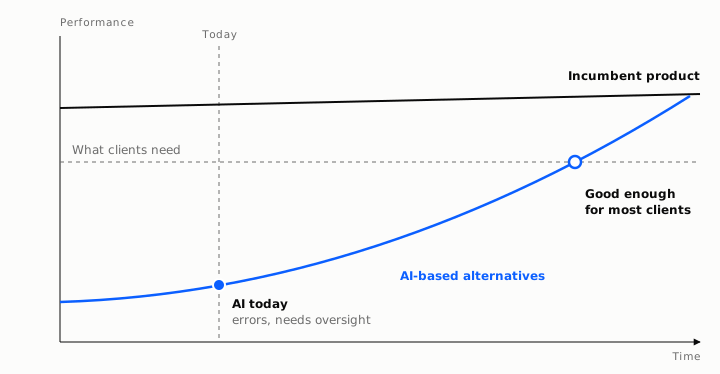
In wealth management, today’s AI makes mistakes. It can’t yet stand up to regulatory scrutiny on its own. And it is still being wired into brokerages, with human oversight as the compensating control.
Most money managers have drawn a reasonable conclusion from this: it isn’t good enough for my clients. For now, that’s true, but it will likely not stay that way for long.
Where incumbents are probably wrong
Three assumptions look reasonable today and are likely to age badly.
- The error rates will stay high. Underestimates the pace of improvement.
- Not enough adoption. Underestimates the threat of consumer platforms making adoption easy.
- A low AUM ceiling. Underestimates ability of brands to build trust. Once the technology is reliable, portfolio construction can scale to accounts holding millions. What gates the larger account is trust, which platforms and brands can build.
The AUM fee is the cash cow
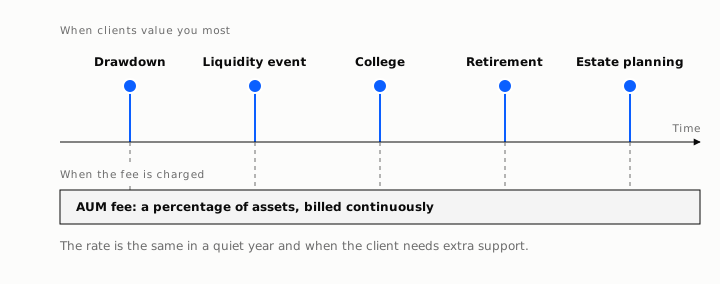
Film was Kodak’s cash cow. Every step toward digital made its own best business smaller. The AUM fee plays the same role in wealth management. It scales with assets, not effort, and it has funded the industry for decades. Cheaper, better portfolio management attacks it directly.
The likely incumbent responses mirror Kodak’s. One is to bolt AI onto the existing model as a productivity tool, which protects the fee but not the franchise. The other is to defend with relationship messaging without changing the offer. Kodak did sell digital cameras. It just couldn’t accept their economics.
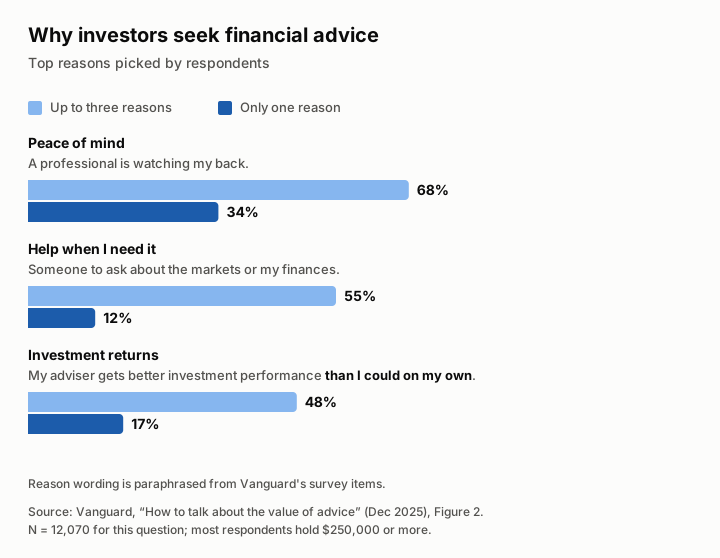
The fee also misprices what clients value. Individual investors seek an adviser more for emotional reasons than portfolio management.1
Those needs show up at specific moments. Instead, the AUM fee is charged continuously, on assets, for portfolio management, and under-bills emotional support and accountability, which clients value most.
The smartphone moment
Digital cameras alone didn’t finish Kodak. The smartphone did, by turning the camera into a feature of a device people already carried. Apple isn’t one of the most valuable companies in the world because of its camera. The value went to whoever owned the device, the customer relationship, and the ecosystem around it. Kodak’s pictures didn’t disappear. They moved to platforms Kodak didn’t own. Instagram sold for about $1 billion in the same year Kodak filed for bankruptcy.
The wealth management version is AI money management becoming a feature of a platform people already trust. Apple is the easiest example to picture. It already runs a wallet, a card, and a savings product. Its model so far is distribution and brand with a regulated partner carrying the balance sheet.
I’m not predicting that Apple launches this. The point is structural. A consumer platform doesn’t need to become a registered adviser. It needs a partner that is one. Google, a large bank’s app, a brokerage with a strong assistant, or a custodian that decides to go direct could do the same. That makes the threat easier to build than incumbents assume, and harder for them to see coming.
So the question for a firm isn’t only whether AI can do portfolio management. It’s where the value in the client relationship will sit once it can, and whether the firm is giving that up, by accident or by design.
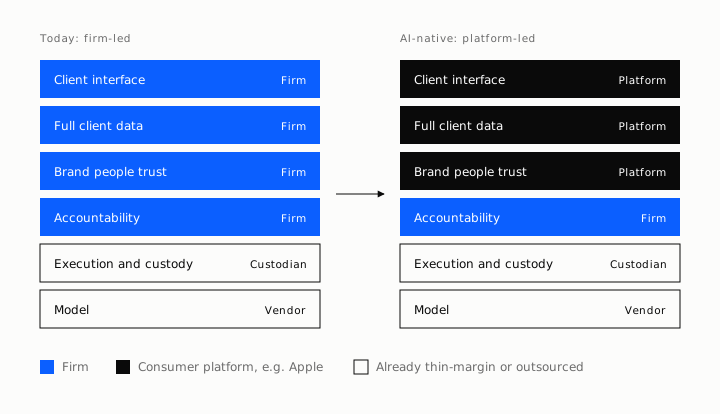
The risk for incumbent firms is that their relationship with the client gets disintermediated, bit by bit, as the AI performance curve improves.
Signals to watch
The tipping point won’t announce itself. These are the signs I’d track.
- Error rates on defined portfolio tasks falling below the human baseline.
- Regulators clarifying what supervised AI-driven advice looks like in practice.
- Custodians and brokerages shipping AI-native managed accounts.
- Consumer platforms partnering with custodians or registered advisers.
- Fee compression moving up from the low end into $1 million and larger accounts.
The last one is the one to take seriously. When pressure shows up in a firm’s larger accounts, it is no longer at the edge of the curve.
Fee models to borrow from: the CPA and the doctor
As we consider updated fee models, it is useful to recall that Kodak sold a product and had no relationship it could charge for. Advisers do.
Fee models in two professions are instructive. When software took the simple tax returns, the CPA moved up to complex situations, where they sign the return, represent the client, and carry liability. When it comes to doctors, my phone helps find one for most things, but I still value a doctor who knows my history, can be reached when it matters, and is accountable. Concierge practices price exactly that, as a retainer for access and accountability rather than per procedure. Businesses have a similar arrangement with outside counsel.
The AUM fee model bundles three things that we could consider unbundling.
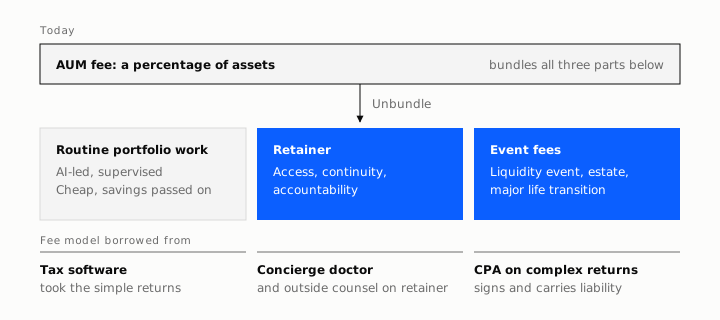
For clients, this is mostly good news. The commodity part gets cheaper. The firms that pass savings on, and explain why, will earn the trust the human layer depends on. Law is already there: the ABA’s 2024 ethics opinion on generative AI says a lawyer billing by the hour may bill only for time actually spent, not for the efficiency AI creates.
What firms should do: plan for near-free portfolio management
The useful exercise is to stop debating whether AI reaches this point and design for the world where it does. Assume AI manages portfolios in the millions at very low fees. What does the business look like?
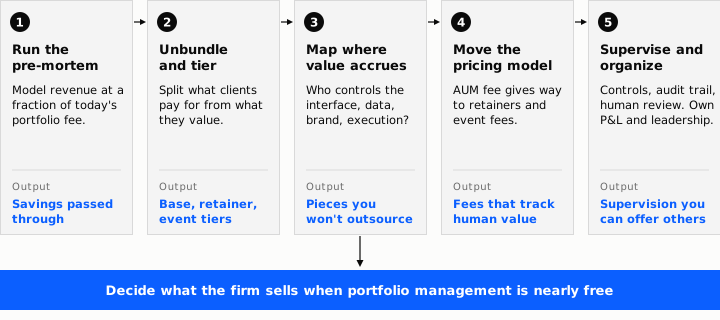
None of this requires predicting which platform moves first. It requires deciding now what the firm will be when clients no longer pay a premium for portfolio management.
The lesson
The lesson of Kodak isn’t that technology wins. It’s that the company saw the change coming and still couldn’t act on what it knew.
Wealth management has something Kodak didn’t: a relationship with its clients that it can price and defend. The question for firms is: which of your clients’ needs could a good-enough AI serve, and what would you sell them instead?
Footnotes
-
Stephen Weber, Paulo Costa and Min Kim, “How to talk about the value of advice”, Vanguard, December 2025, Figure 2 (“Why do you get financial advice?”). Online survey fielded July 2025; N = 12,070 for this question; most respondents hold $250,000 or more. The chart shows three of the reasons Vanguard listed, with the wording paraphrased. The returns item asks about the adviser’s performance relative to what the respondent could achieve alone, not relative to a market benchmark. ↩